Freelancers: Own the Result, Not Just the Effort
The bread you bought means nothing if it doesn't belong on the dinner table. For freelancers, the same brutal truth applies to every project.

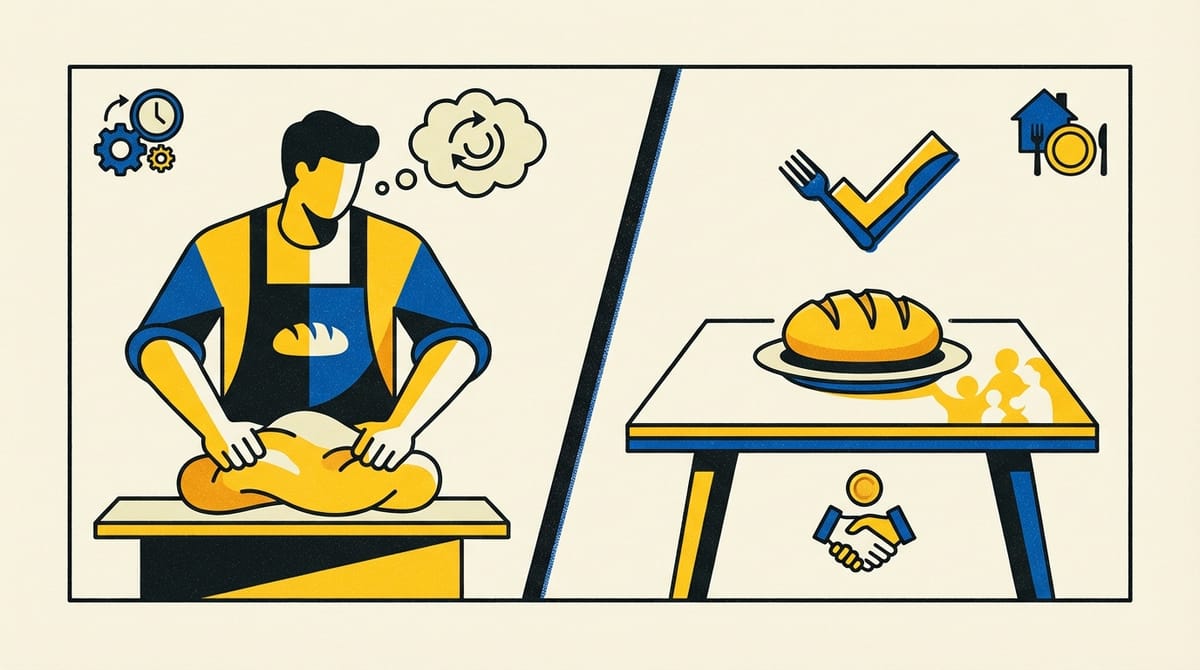
Your wife says in the morning: "Pick up some bread." Simple task. What's there to think about — stop by the store, grab a loaf, bring it home. Done. No medal required, but the job's complete.
Or is it?
That evening you sit down for dinner. Fresh bread should be on the table. Not yesterday's loaf that crumbles under the knife like it's getting revenge for something. Not that rock-hard discount brick you could hammer nails with. Not a baguette when your wife made borscht — because borscht with baguette is certainly avant-garde, but she won't appreciate it the way you're hoping.
The bread that goes with dinner. The bread that's actually good to eat.
That's the result. Not the act of buying — the value on the table.
Effort is not the same as results
At work it's exactly the same — just somehow less obvious.
A designer gets a week to create a website mockup. He works honestly — stays late, cycles through options, consults colleagues, drinks coffee in industrial quantities. Monday comes, he shows it to the art director.
"Done?"
"Yeah, here!"
"This won't work. It's a mess here, unreadable there, this part's completely off-brief."
"But I tried so hard. I spent so much time on it..."
And here's where it gets interesting. The designer genuinely believes he "did it" — because he worked. He sat there! Stayed late! But the art director sees something else: the mockup can't go to development. No result.
Who's right? Both are sure they are. But here's the truth: effort is process. "Done" is result. You can try your absolute hardest and not deliver. And you can deliver easily and quickly — and go home on time. Only the outcome matters.
When you do everything right — and still don't deliver
Okay, you might say, the designer's fault — he should have worked better. Fair. But it gets harsher. When you do everything right — and still don't deliver.
Hemingway's Old Man goes out to sea alone. Finds an enormous marlin. Fights it for three days — no food, no sleep, hands cut to ribbons. And wins. Ties the fish to his boat and sails home. This should be the triumph. Music swells, credits roll.
But on the way back, the sharks come. One, then another, then a pack. Santiago fights them off — with an oar, a knife, his bare hands. Useless.
He reaches shore with a skeleton.
The process — heroic. Three days of battle that deserve a standing ovation. The result — bones on the dock. And no amount of applause will put that fish back together.
When you did your part — and someone else didn't
But there's something even more frustrating. When you did your part — and someone else didn't do theirs. And there you stand, a knight in shining armor who rode in to save the princess, but the castle's under renovation and the dragon's on vacation.
A freelancer delivers a project. Everything per spec, on deadline, revisions included. One thing left — get paid. Client says: "I'll wire it next week." A week. Two weeks. A month. "Yeah, yeah, soon" — then silence. Sound familiar?
The freelancer did everything right. The client's behaving terribly. But here's the question: whose bank account is empty?
Not the client's. The client's using the finished product. The freelancer's sitting broke, figuring out how to make rent.
Responsibility means control
Bread, the designer, Santiago, the freelancer. Four stories. Different scales, different degrees of unfairness. But one conclusion.
If you take on a task — you own the result. Not circumstances, not other people, not "objective reasons." You.
That's a hard truth. I know. You want to say: "But that's not fair!" — and you'd be right. It's not fair. But this hardness — it's also what sets you free.
Because if the responsibility is yours — so is the control. You can do something: find another path, escalate the problem, switch vendors, demand payment upfront. Act.
But if you blame circumstances — you stay helpless. Like that knight at the closed castle — standing there, fuming, and the princess still isn't saved.
Back to the bread
"Done" isn't buying bread. "Done" is the right bread on the table at the right time.
What "not done" looks like:
- Forgot to buy it? Not done.
- Bought the wrong kind? Not done.
- Bought it, but it turned out stale? Also not done.
- Bought the right one, but dropped it in a puddle on the way home? Yeah, you get it.
Result is value in the world of whoever you're delivering to. Your wife needs bread for dinner. The art director needs a mockup ready for development. The client needs a product that solves their problem.
Everything else is process. It can be long or short, agonizing or easy, heroic or mundane. But only the result gets judged.
Now go buy that bread. The right one.