How to Learn to Delegate Tasks to Others
Master the art of delegation to enhance productivity and trust within your team—stop being the bottleneck and lead effectively!


A leader who does everything themselves is not a leader, but an executor with an inflated salary. Over 18 years in management—from restaurants to defense—I've learned one thing: delegating tasks isn't about "offloading work." It's about how to stop being the bottleneck of your own team.
Table of Contents:
- What "delegating responsibilities" means
- When and which tasks can be delegated to subordinates
- The trust problem — what to do about it
- How to control the task delegation process
- How to develop your delegation skills
What "Delegating Responsibilities" Means
Read the phrase "delegating responsibilities" literally—you're transferring part of your existing responsibilities to a subordinate. All three components are important here:
- Transfer—meaning now it's done by another person and that person is also accountable. They have the right to claim ownership of the results of their work, rather than be considered an assistant in a task you're completing.
- Existing responsibilities—meaning you already know how to do something correctly; there's a business process or execution methodology. You can teach this.
- To a subordinate—meaning to a person over whom you have authority: to assign tasks, monitor, accept work, etc.
Asking a colleague to cover for half a day isn't delegating responsibilities. Asking a subordinate to do something new that you haven't done yourself yet is an assignment, but not delegation of responsibilities.
When and Which Tasks Can Be Delegated to Subordinates
Clear signs that it's time for a manager to delegate tasks:
- deadlines are pressing, and the workload keeps growing;
- simple tasks take up too much time;
- minor tasks cause the manager to lose focus, preventing them from concentrating on what only they can do.
The Eisenhower Matrix helps here. It's a graphical prioritization method where tasks are divided into four groups based on urgency and importance:
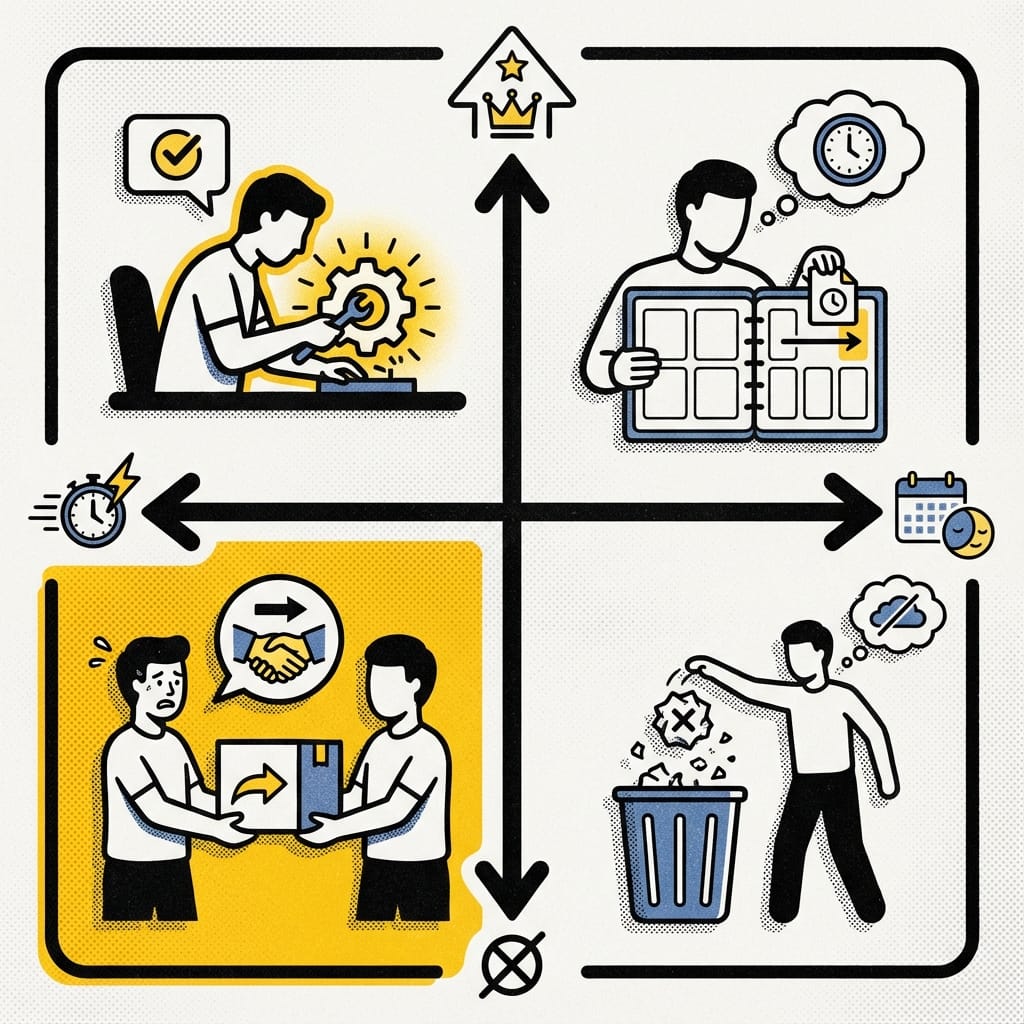
We're interested in the bottom-left quadrant: we break tasks down by category and delegate urgent but unimportant matters.
Examples of tasks that can be delegated:
✅ Organizing routine meetings and briefings
✅ Executing test versions of projects
However, urgent and important matters cannot be delegated to subordinates. Only the manager is responsible for making decisions that are significant to the company.
Do not delegate:
❌ Organizing processes
❌ Firing and reassigning personnel
❌ Training and onboarding new employees
Non-urgent but important matters can be delegated only if you're confident in the employee's competencies. It's useful to set checkpoints and monitor task progress so that both you and the executor are confident in the outcome.
When I managed training at Burger King across 12 restaurants, I had 4 regional trainers and 18 local ones. If I had conducted every training session myself, I physically wouldn't have been able to open 5 new locations in six months. I delegated the organization of routine sessions to the trainers and kept only the evaluation system and checkpoints for myself. The result: +44% in training effectiveness, +31% in quality.
The Trust Problem — What to Do About It
There's a common saying: "If you want something done right, do it yourself." But what if you assign a task and the person doesn't complete it the way you need? Here are a few approaches that will help you feel more confident in delegating tasks.
Develop your employees' skills. Sure, the team learns on its own — but not as quickly as you need. And your job as a manager is to organize a conscious and structured learning process.
Create a control system. No one can read your mind and determine what good work means to you. You need to document it and communicate it to your people. You'd like them to somehow figure it out on their own, but that won't happen.
Rethink your approach to mistakes. Mistakes are part of learning and growth. Once you understand that small mistakes aren't catastrophic, it becomes easier to entrust part of the work to your team.
At Russian Helicopters, I worked with a team that prepared training for military pilots. The cost of an error — literally a life. But even there, it's impossible to control every step. What worked was different: clear readiness criteria at each stage and the right to make mistakes in test versions. The final result was checked rigorously, but the path to it was not.
There's a vicious circle: "Do it yourself → no time to teach others → have to do it yourself." Whoever breaks this cycle will master delegation. Whoever doesn't—won't.
How to Control the Task Delegation Process
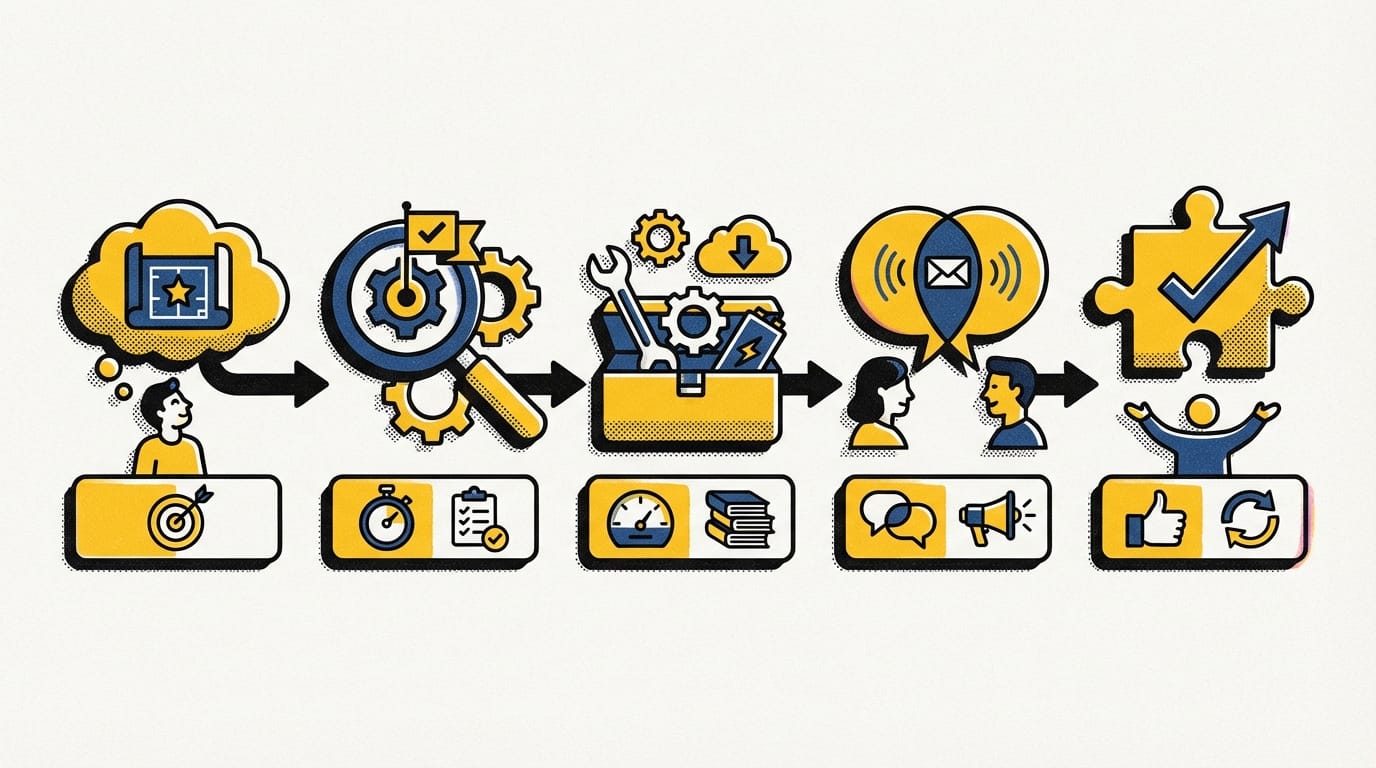
Five key points that will help you establish healthy control over task execution:
- Clear expectations. Discuss tasks, deadlines, and desired outcomes.
- Checkpoints. Set intermediate milestones to assess progress and make adjustments.
- Resources. Make sure the employee has everything necessary to complete the task—tools, information, support. Under no circumstances should you launch a process for which you don't yet have the full set of resources—this creates loss of focus for everyone.
- Regular communication. Hold meetings or ask questions as the task progresses. This will help identify potential problems at an early stage. Yes, this is separate additional work—but it's your work.
- Feedback. After the task is completed, discuss successes and areas for improvement so the employee can continue to develop. It may seem like, well, that's it, enough meetings and talking, the task is done—and that's good. But your people will appreciate that you talked with them.
How to Develop Your Delegation Skills
For any skill, experience and exposure are important. You assigned a task, and the person didn't complete it — okay, it happens. The key here is to ask yourself questions: why did this happen? What can I change next time to avoid the same mistake: replace the executor, explain the task in more detail, delegate only part of the task?
Delegation is a skill that takes practice. The first few times will be clumsy, something will go wrong, you'll want to go back to "I'll do it myself." This is normal.
The main thing is not to stop. Every task you delegate frees up time for what only you can truly do.
I'm Aleksandr Kosenko — a product manager with experience managing teams of up to 200 people. I write about how to work with people, systems, and yourself.