How to Prevent Project Dumpster Fires Before They Start
That satisfying moment when someone delivers work they're proud of—and the stakeholder hates it? It's not laziness. It's a predictable failure with a fixable cause.

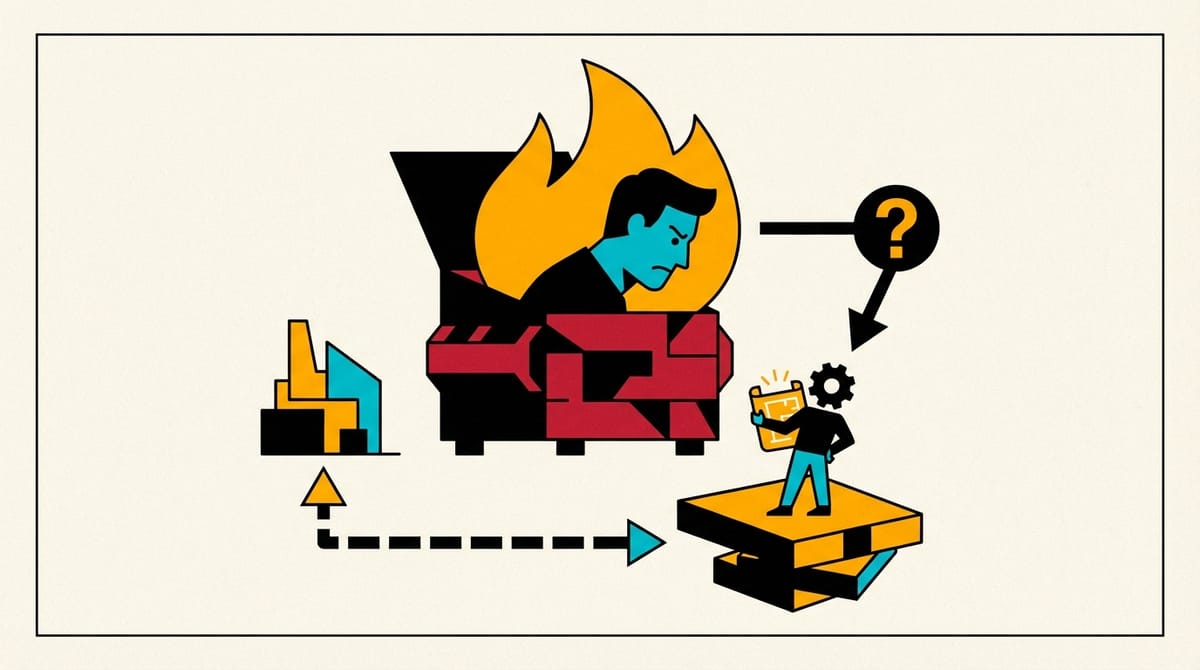
In every company on Earth—from Berlin to Buenos Aires—there's a scene that plays out with the regularity of migrating birds.
Someone gets a task. Deadline: one week. They leave. They work. A week later, they return with the result and an expression that says: "Appreciate this. I poured my soul into it."
The stakeholder looks. The stakeholder does not appreciate it.
- This isn't quite what I meant.
- But I worked on it for a week!
"I worked on it" is one of the most useless phrases in management. It belongs in the same trash bin as "we've always done it this way" and "in theory, this should work." All three mean the same thing: something went wrong, but we haven't figured out what yet.
A surgeon doesn't say "but I really tried" after a botched operation. A pilot doesn't say "but I prepared so much" after landing at the wrong airport. Yet in projects—somehow it's acceptable. Worked hard, gave it their all, poured in their soul. The result is a dumpster fire, but hey, the soul was poured.
If you've ever been on either side of that table—keep reading. We're about to break down why this happens and who's to blame. Spoiler: not the person doing the work.
Three types of executors
Give three people the same task with the same deadline—and you'll get three completely different disasters. Well, or one non-disaster. But we'll get to that.
The Optimist
The Optimist has a wonderful sense of time. It always shows them more than actually exists.
A week for the task? That's five working days. Plus evenings. Plus weekends. When you think about it, that's almost twenty four-hour slots. No need to rush. Better to "understand the topic first." "Gather some references." See how others have done it.
By Wednesday, the Optimist is still gathering references. By Friday, the nerves kick in. By Sunday, they heroically finish the first—and only—version.
Monday. Result on the table. Two pages of revisions. Time to fix anything: zero. Everyone's unhappy, but especially the Optimist: they tried so hard.
If you're a manager and just recognized your team member—remember: the Optimist doesn't need motivation. They need checkpoints. Not "show me Monday," but "show me a draft Wednesday, second version Friday." The Optimist can't structure time on their own. Structure it for them—and you'll get a solid contributor.