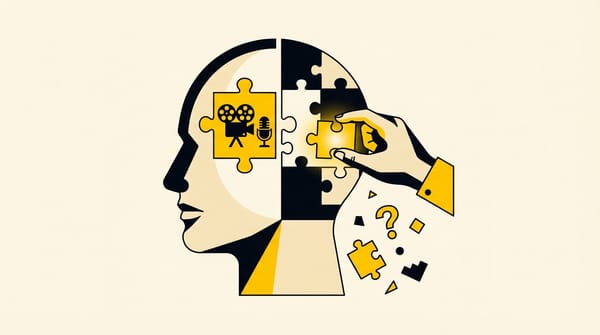
Six words in a Moscow café cracked open self-blame I'd carried for years
Six words in a Moscow café rewired how I talk to myself — because the thoughts running quietly in the background shape more of your life than any big event ever will.


Small thoughts that run everything
For the longest time, I believed life changed through big events — moving to a new city, landing a new job, some dramatic turning point. But over time, I noticed something different: outcomes aren't shaped by events. They're shaped by daily habits. And not habits of action — habits of thinking.
Think of them as pebbles piling into a mountain. Each one on its own? Nothing. But after a year, after three — that's the landscape you live in.
When a bad thought is worse than a cigarette
We're used to thinking about habits as actions: smoking, endless phone scrolling, binge-watching until 2 AM. But behind every action is a thought. Actions are just the follow-through.
Here's an example. If I'm convinced that public speaking isn't my thing, my project stays invisible. The world never hears about my idea. Not because the idea sucks — but because one small thought, "that's not for me," blocked the road.
Toxic thoughts about yourself can be worse than cigarettes. If I think I'm not worthy, I simply don't see opportunities. They're right there, but my brain filters them out.
Six thinking habits that helped me
Replace judgment with observation
The brain works like an old guard dog — always scanning for threats, usually spotting only the bad stuff. That's useful if a bear is chasing you. In regular life, though, this automatic judgment gets in the way.
The brain takes 0.3 seconds to evaluate a person. We haven't even opened our mouths, and it's already "case closed." But if you swap "case closed" for "that's interesting" — a completely different perception opens up.
"I wonder what happens if I try?" — that sentence opens doors that "obviously, this won't work" slams shut.
Ask "Why not yes?" instead of "Why not?"
The brain is like an executive assistant. Whatever question you ask, that's the answer you get. Ask "why will this fail?" — it'll find twenty reasons. Ask "how could this work?" — it starts looking for options.
What helped me was dreaming first — giving myself space for "yes." Then plugging in critical thinking later, at the "okay, how exactly do I do this" stage. Don't mix the two processes.
Don't rush to answers
Quick answers are like fast food for the brain: fast, but not always good for you. Emotions always outrun reason — they process faster. And when I answer instantly, it's usually my emotions talking, not me.
Time helps you make a better call. Sometimes a few seconds of pause is enough. Sometimes it's worth saying "let me sleep on it." That's not weakness — it's respecting the complexity of the question.
See failure as a "try again" signal
The brain stores failures so you'll avoid them next time. Survival mechanism. Burned yourself — don't touch. But in adult life, this often works against us.
A bad date isn't the end of the world. A bombed presentation isn't a life sentence. It's a reason to try again, differently. Failure isn't a stop sign — it's a "recalculate route" signal.
Stop reading other people's minds
I caught myself doing this weird thing: filling in what other people are thinking. Knowing in advance what someone will say. Even getting offended by words they haven't said yet.
Honestly? It's a trap. Nobody's obligated to read my mind, and I'm not obligated to read theirs. Conversation — actual talking and checking — beats making assumptions and getting hurt every time.
Replace "but" with "and"
This sounds tiny, but try it. "That was great, and here's what we could improve" lands completely differently than "that was great, but you need to understand..." The first one opens a conversation. The second one erases everything that came before "but."
One small word swap — and communication transforms.
It all starts with a small step
I didn't wake up one morning with a new brain. These were small steps, every day. Noticing an automatic judgment. Catching myself inventing someone else's thoughts. Holding a pause before responding.
None of these steps looks significant on its own. But pebbles pile into a mountain — and one day you realize you're standing in a completely different place.
For the longest time, I believed life changed through big events — a move, a new job, a turning point. Then I noticed something else: events give you raw material. What you build from it depends on how you're used to thinking. Not acting — thinking. The thoughts that loop on autopilot, every day, in the background — they're what shape the landscape you live in.
Let me show you how this actually works.
End of summer, Moscow, the terrace at Coffemania near Kitay-gorod. We're sitting wrapped in blankets next to patio heaters, drinking coffee and talking. I've just gone through another relationship failure, and my brain is doing what it always does: looking for the cause inside me. Not in the circumstances, not in incompatibility — in me. Automatically, effortlessly, like breathing.
And then someone starts telling me about myself — not consoling, not advising, just... telling. About my habits, my actions, how I affect people around me. You know how it is when you pull up a dill root — the thin roots have spread far underground, you tug, it resists, and then suddenly it starts coming, pulling through slowly, carefully, without breaking, barely any soil clinging to it. They reminded me of a phrase that used to go around the Burger King where I once worked. Customers thought I was flirting with them, tried to find out from my coworkers — is he into me? — and they'd say: "No, that's just Sasha. Sasha's like that."
One sentence pulled up everything good that had accumulated over years — like those roots that don't break.
I got on the commuter train, rode home, and realized I was no longer thinking about the relationship failure. I was thinking about how the habit of searching for the cause of every setback inside myself had been blocking my view for years. Good things were right there, but my brain wasn't showing them — it was busy running a different search.
Cognitive therapy described this mechanism long ago. Psychiatrist Aaron Beck called them "automatic thoughts" — interpretations that fire instantly, without conscious involvement, and feel like fact. Martin Seligman took it further and identified three dimensions people use to explain failure to themselves: temporary or permanent, specific or global, personal or situational. "I got rejected because I always ruin everything" — permanent, global, personal. "It didn't work out because the circumstances didn't align" — temporary, specific, situational. Same fact, two ways to read it, and the first one predicts depression with an accuracy that surprised Seligman himself.
This isn't a "think positive" pep talk. It's a concrete, measurable pattern you can catch and change. Here's how.
Notice
The autopilot we trust
Daniel Kahneman, Nobel laureate, described two thinking systems. System 1 runs fast, automatic, effortless — it makes most of our daily decisions, and we don't even notice. System 2 is slow, deliberate, energy-expensive — it kicks in only when we force ourselves to think.
How fast is the first one? Alexander Todorov at Princeton showed that the brain forms a judgment about a stranger in one hundred milliseconds — a tenth of a second. In the time it takes to blink, you've already "figured out" the new person. That's an inheritance from ancestors who had to decide instantly — run or don't. The amygdala processes a threat signal before the cortex can even make sense of the situation — neuroscientist Joseph LeDoux called this the "low road."
Speed itself isn't the problem. The problem is that we take our first reaction as truth and stop checking. In my case, the "low road" looked like this: something went wrong — brain instantly delivers "look for the cause in yourself." Not "maybe it just didn't click," not "maybe it's not about you" — straight to verdict. And for years I accepted that verdict without questioning it.
In Acceptance and Commitment Therapy, there's a technique called cognitive defusion: you don't try to cancel the automatic thought — you change your relationship to it. Not "this is true," but "I notice I'm thinking this." One shift, but it hands you back a choice — agree with the autopilot or switch to manual.
Name it to disarm it
Matthew Lieberman at UCLA discovered a technique so simple it's hard to believe. He scanned the brains of people who labeled their emotions out loud or silently — "I'm angry right now," "I feel anxious." Amygdala activity dropped. The prefrontal cortex — the part of the brain responsible for conscious decisions — switched on. One short sentence inside your head, and the "slow road" catches up with the "fast" one.
It's called affect labeling — one of the most reliable findings in the neuroscience of emotion. No meditation, no therapist, no hour of silence. Just tell yourself "I'm irritated right now" — and you're no longer a hostage of the reaction. You're an observer who gets to choose what happens next.
In practice, this is about the pause. When I'm angry and respond instantly — my emotions are responding, not me. Six to ten seconds — that's how long the cortex needs to intercept control from the amygdala. Sometimes those seconds are enough. Sometimes it's better to say "let me think about it until tomorrow." That's not weakness — it's respecting the complexity of the question.
Reframe
The question you ask is the answer you get
The brain doesn't work like a search engine delivering an objective picture of reality. It's a prediction machine: it builds a hypothesis and obediently looks for confirmation. Ask "why does nothing ever work out for me?" — and it'll find twenty reasons, each more convincing than the last. Ask "what am I doing that actually works?" — and it starts searching for something else entirely.
Tversky and Kahneman demonstrated this experimentally back in 1981: the same situation, described differently, leads to opposite decisions. They called it the framing effect. The frame you put around a question predetermines the answer.
For years I kept asking myself one question — "what did I do wrong?" — and my brain dutifully delivered answers. But that evening on the terrace, someone essentially asked me a different question — not in words, just by telling me what they saw from the outside. And my brain switched. Turns out the answers were always there. The question just hadn't been asked.
Since then, I try to separate two processes: first I ask "what if this works?" — no criticism, no "but," just space for possibilities. Critical thinking comes later, at the "okay, how exactly" stage. Creativity research formalized this long ago as divergent and convergent thinking: generate first, then select. Mixing them is like pressing the gas and brake at the same time.
One word changes everything
Marsha Linehan, creator of Dialectical Behavior Therapy, taught patients to replace "but" with "and." The difference seems laughable until you try it.
"I'm scared, but I'll try" — a fight with yourself, where one side has to win. "I'm scared, and I'll try" — both feelings exist at once, neither cancels the other. Linguistic research backs up the mechanism: the brain processes "but" as a signal to cancel the previous statement. "You did great, but..." — everything before "but" gets zeroed out.
This doesn't only work in conversations. Ethan Kross at the University of Michigan studied inner speech and found that the structure of self-talk directly affects emotional regulation. Even replacing "I" with your own name — "Sasha, you've got this" instead of "I've got this" — reduces anxiety. Small linguistic shifts trigger real neural rewiring.
Verify
Mind-reading kicks in during silence
In conversation, I pick up on context fast and often know what someone's about to say next. That's a skill, and it helps. But the real problem starts when there's no conversation — when someone just disappears. Ghosting creates a data vacuum, and the brain immediately fills it with narratives. And those narratives follow the usual pattern.
My pattern is well-known by now: someone stops responding — System 1 instantly fires "what did you do wrong?" Not "maybe they have their own reasons," not "maybe it's not about you" — straight inward. Silence fills up with guilt. Absence of a reply becomes proof.
In cognitive therapy, this is called mind reading — one of the fifteen cognitive distortions described by Aaron Beck. The brain really does model other people's thoughts — there's an entire neural network responsible for it, called theory of mind. But the models are built not on facts, but on projection: we attribute our own fears and expectations to others. And here's the surprise: the closer the relationship, the more confident we are in our guesses — but accuracy doesn't improve. We don't get more accurate. We get more confident. A textbook trap.
There's only one way out — check. Ask, don't assume. It sounds obvious, but behind that obviousness sits a fundamental rule: a hypothesis without verification isn't knowledge. It's fantasy.
Failure teaches, if you let it
The brain stores negative experiences more strongly than positive ones — one of the most consistent findings in psychology. Roy Baumeister and colleagues titled their review paper bluntly: "Bad is Stronger than Good." Losing a hundred dollars hurts twice as much as finding a hundred dollars feels good. Evolutionarily, this makes sense: the ones who remembered dangers survived. But in modern life, this bias often keeps us from moving forward.
That said, "try again" only works if you try differently. In the science of mastery, this is called deliberate practice — not mindless repetition, but analyzing the mistake and intentionally changing the approach. The difference between persistence and stubbornness is reflection.
There's also a surprising flip side: research on post-traumatic growth shows that forty to seventy percent of people who've gone through serious setbacks report positive changes — reassessed priorities, stronger relationships, opportunities they hadn't noticed before. This isn't comforting "everything happens for a reason" talk. It's a documented phenomenon: failure reorganizes your value system, if you let it.
Looking back, I see that despite the pain and everything that came with it, going through it turned out to be valuable. But that's correlation, not proof. I keep that in mind.
Honest about the difficulty
I don't want to wrap this up with "start with a small step and everything will change." Because that's a half-truth.
Cognitive habits are among the most stubborn structures in the psyche. Cognitive behavioral therapy budgets twelve to twenty sessions with a specialist to shift them. Neuroplasticity is real — the brain genuinely rewires itself — but not over a weekend. MRI studies show measurable changes in brain activation after eight weeks of daily mindfulness practice. Eight weeks.
But there's one technique that works faster than the rest. Psychologist Peter Gollwitzer found that the "if-then" format doubles the likelihood of following through on an intention. Not "I'll start noticing automatic thoughts" — that's an abstraction. But "when I catch myself looking for the cause of someone else's behavior inside me, I'll say: stop, check." A specific trigger — a specific response. Over time, this becomes a new habit that replaces the old one.
The last two months, I've been living in an unfamiliar state: I can tell myself "yeah, I'm okay" — and believe it. Before, ghosting would set off a catastrophe — silence turned into a verdict. Now it's an unpleasant aftertaste and "well, okay." This isn't enlightenment. This is two months. I don't know if it'll last.
Thinking habits don't change with a snap of the fingers. But they do change — if you know what to catch, and honestly admit that eight weeks is the optimistic scenario. And correlation isn't proof. But sometimes correlation is enough to keep going.