Stop Rereading: The Critical Technique to Enhance Memory Retention
Your brain mistakes familiarity for mastery—and that cozy feeling while rereading is actually the sound of nothing sticking.

How to Learn How to Learn: An Introduction
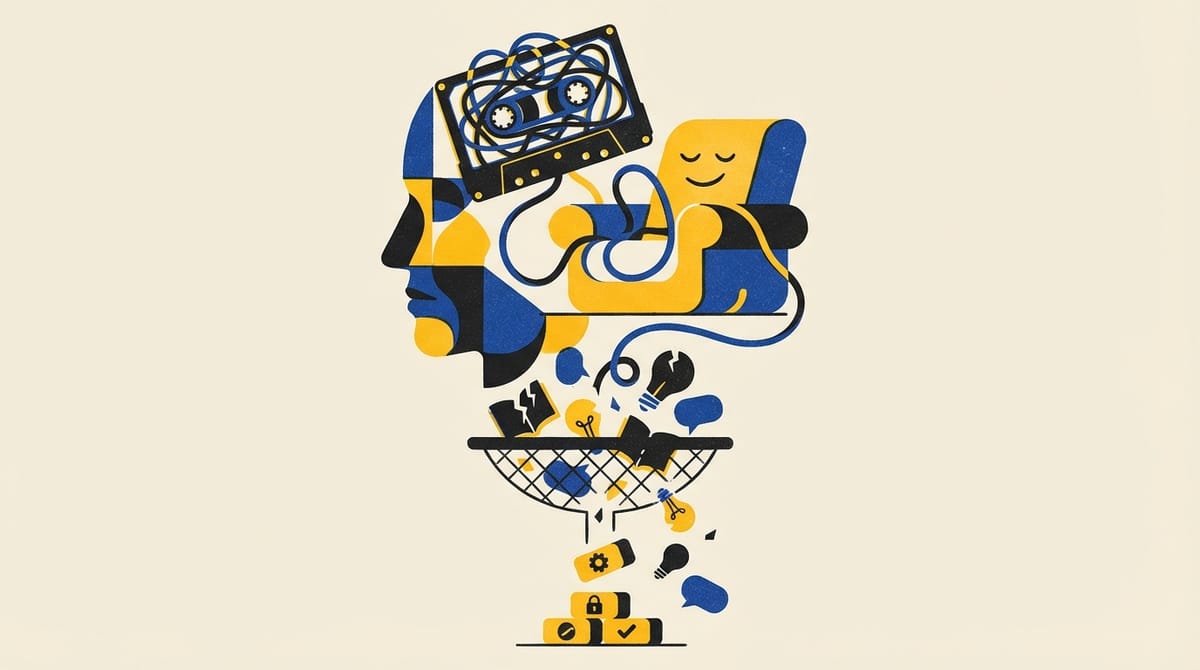
Sunday, 11 PM. You're rereading your notes for the third time—and with each pass, the text feels cozier, almost like a lullaby. "Got it," your brain announces, settling comfortably into the armchair of confidence. Tomorrow's exam arrives. Emptiness. Silence. Tumbleweeds rolling through your skull.
Here's the thing: familiarity with text and understanding of material are so different they should be kept in separate rooms and forbidden from speaking to each other. But your brain confuses them—and, credit where it's due, does so with remarkable consistency.
If you only have patience for one section of this letter—make it the next one. It contains exactly one technique you can try right now, without reading to the end. Seriously. The rest can wait.
One Technique That Works
Close this article. Right now. Grab paper (or a phone note—it's the 21st century) and write down everything you remember about the last material you studied. A book chapter, a course module, documentation—whatever. No peeking. Then open the source and compare.
What you just did (or, let's be honest, decided to do "a bit later") is called retrieval practice—actively pulling information from memory. And here's where it gets interesting.
A meta-analysis of 242 studies with 169,000 participants showed: testing yourself produces an effect size of d=0.70, while rereading hits only d=0.54. That's roughly 30% more effective. Thirty percent! For five minutes of work instead of an hour of passive reading.
Memory works like a forest path. Walk it once—the grass springs back up like you were never there. But each retrieval is another pass. The path grows deeper, clearer, more reliable. Eventually, you can walk it with your eyes closed.
What to do: After every chapter, lecture, video—close the source, write from memory, check. Five minutes. Every time. No exceptions, even when you're sure you "already got it."
Why We Abandon Courses
Now let's talk about the elephant in the room. Or rather, the graveyard of online courses in our accounts.
Admit it—every one of us has abandoned an online course before reaching the halfway mark. Hoarded materials to study "someday" (that magical "someday" whose reliability rivals only the promise to start jogging Monday). Or couldn't understand why homework mattered when "everything's already clear."
The numbers confirm it: online course completion rates in 2025 hover below 15-25%. Three-quarters of starters never finish. But here's what matters: the problem isn't the courses. The problem is how we learn.
When you're your own teacher, coach, and sensei rolled into one—no external structure, no grades, no obligations. Just you alone with the material, like a knight facing a dragon but without sword or horse. And here's where science enters: a meta-analysis of self-regulated learning showed that about 80% of successful online learning connects to self-regulation strategies—planning, monitoring progress, reflection. Not content quality. Not the instructor's reputation. How you work with material.
What to do: Accept this as fact—responsibility for learning sits with you. No teacher, however brilliant, can "install" knowledge into someone else's head. But techniques exist that turn this chaotic process into something predictable. More on those ahead.