Struggling to Learn? Understand the Two Brain Modes
That familiar feeling of blanking on an exam? It's not a memory problem—it's a mode problem. Your brain switches between focus and drift, and most people never learn to use both.

How Thinking and Memory Actually Work
Here's a scene you know. Sunday, midnight. You're rereading your notes for the third time. The text looks familiar. Feels like you know it. Tomorrow at the exam you flip open the question and... nothing. Where did it all go?
If you only read one section — make it the next one. There's a technique you can use right now.
Why Your Brain Sabotages Learning
Ever had this happen: you're reading something new, and you can literally feel your brain resisting. Straining. Loading. You want to close the tab and watch something easier.
That's not laziness. That's your brain conserving energy. It doesn't want to build new neural connections — too expensive. Easier to use what's already there. No point yelling at it. You have to work with it.
And here's what's interesting: the mechanics are identical. Doesn't matter if you're learning Python after ten years in marketing, German for a move abroad, or financial modeling for a new project. The brain follows the same rules.
Technically, it doesn't reproduce reality itself — just a projection of it. Like the navigation app on your phone. Except everyone's got different maps in their head. These maps are created by two thinking modes, and switching between them is the key to remembering.
Two Modes: Focus and Drift
Psychologist Lev Vygotsky, observing how children develop speech, noticed something: a child under two says words but doesn't understand their meaning. Just reproduces sounds.
Picture this: you walk up to a two-year-old designer and say, "John, can you have the mockups ready by Tuesday?" "Mockups!" the tiny designer confidently repeats. Tuesday comes — no mockups. It's not that John doesn't care. He's just reproducing sound without grasping meaning.
Here's the thing: adults do this constantly.
Say you're dropped into a room full of data scientists. All day you hear about gradient descent, feature engineering, cross-validation. You could sit there for weeks and understand nothing. Even if they feed you pizza.
Listening doesn't work. You need the understanding stage — active processing, questions, attempts to explain in your own words. From a thinking perspective, learning is about finding the true meanings of words and building connections between them.
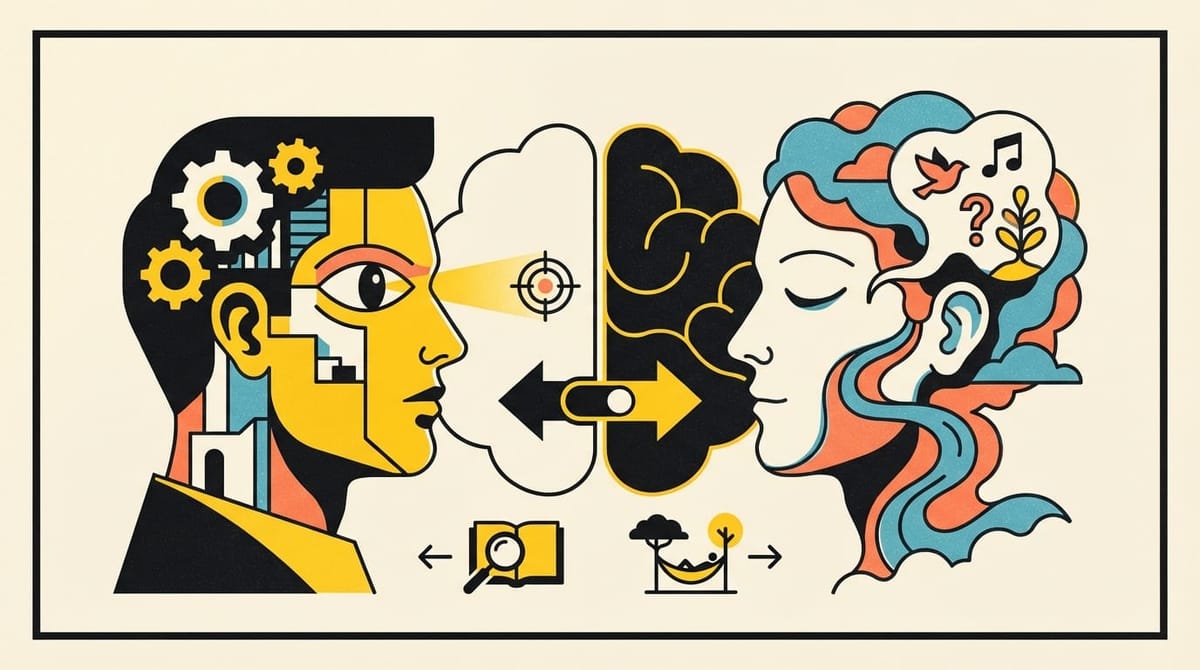
But there's a catch. The brain operates in two modes, and understanding how they switch explains most learning problems.
Neuroscientist Barbara Oakley calls them focused and diffuse modes. When focused mode is running — you're concentrated on a specific task. Solving an equation. Writing code. Parsing documentation.
But the moment you hit something unfamiliar — you get stuck. That's when diffuse mode kicks in.
Research from 2025 showed: diffuse mode is handled by the Default Mode Network — a brain network that's active when you're "not thinking about anything." Shower. Walk. Falling asleep. These are exactly the moments when your brain creates new connections between concepts.