The Brutal Truth About Sleep, Movement, and Stress for Freelancers
Your brain files memories while you sleep, your focus tanks without movement, and stress hijacks everything—yet freelancers optimize everything except these three fundamentals.

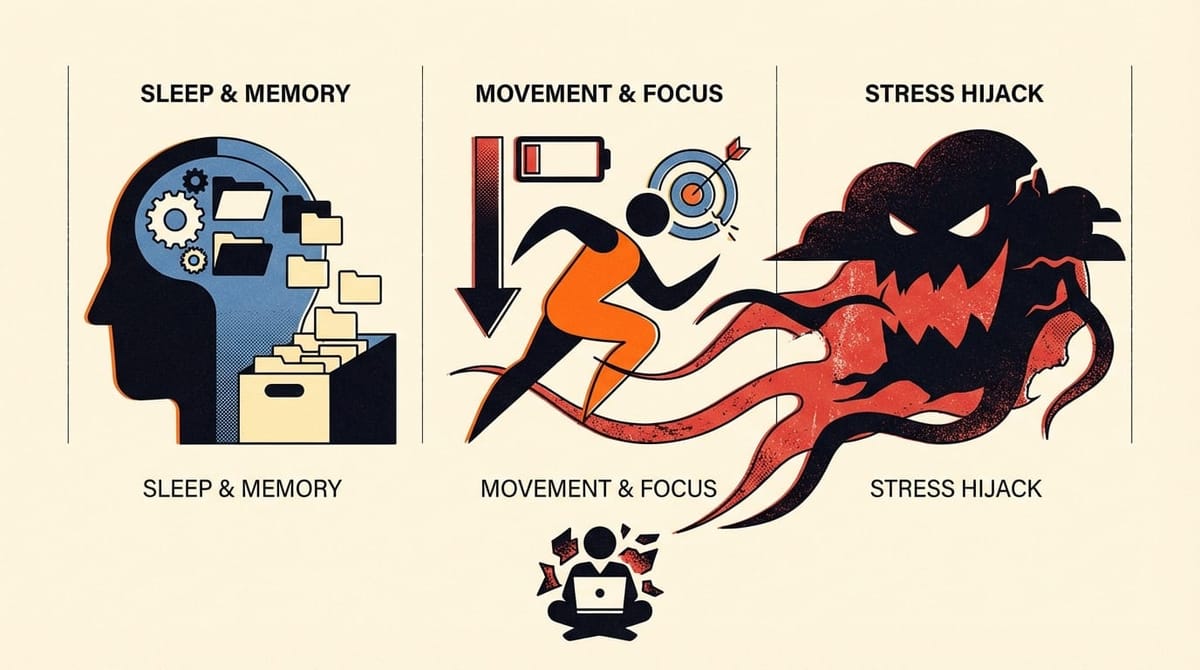
Sleep, Movement, and Stress: The Three Variables That Decide Everything
Eleven p.m. Tomorrow you've got an important call, need to figure out a new API. You open the documentation—and two hours later find yourself on episode five of a show. Or in an endless feed. Or reading an article about how to learn properly.
Ironic, right?
Here's the weird part: we buy productivity courses, download focus apps, read about the Pomodoro technique—but ignore three basic things that everything else depends on. It's like trying to speed up a car with flat tires.
If you only read one section—make it the sleep one. Because everything else works at half capacity if you're sleeping five hours.
Self-Diagnosis: Where's Your Bottleneck?
Stop. Before reading further, answer three questions honestly:
- How many hours did you sleep the last three nights?
- Did you get more than 10 minutes of physical activity in the last 48 hours?
- Rate your anxiety level right now from 1 to 10.
If sleep is under 6 hours—start there. If activity equals zero—start there. If anxiety is above 7—start with stress.
You don't need to change everything at once. One variable. One week.
On Sleep
Here's what I figured out after a week of sleeping four hours and wondering why my code wouldn't compile: sleep isn't for the weak. Sleep is when your brain does the real work.
A 2024 Bayesian meta-analysis confirmed a mechanism neuroscientists had suspected for years: slow-wave sleep and so-called "sleep spindles" work in tandem. They literally transfer information from temporary storage—the hippocampus—to the cortex, where it stays long-term.
Picture this: during the day you jot notes on sticky notes. At night your brain files them into folders. Without sleep, the stickies pile up, fall on the floor, get lost. And you're surprised yesterday's material evaporated from your head.
A 2025 Nature study went further: turns out if you pair material with a smell or sound, then replay that stimulus during sleep, consolidation gets stronger. This is called targeted memory reactivation. Sounds like science fiction, but it works.
How much sleep? Data from the Global Council on Brain Health and 2025 JMIR research converge: 7-8 hours is optimal for adult cognitive function. Less—you lose concentration. More than 9—also a problem: cognitive function declines, especially if there are sleep disruptions.
And no, it's not because "the body produces too much melatonin." Melatonin is regulated by light, not sleep duration. Grogginess after long sleep is wake-up inertia from a deep phase, plus disrupted circadian rhythms. The fix isn't "sleep less"—it's waking at the same time and getting bright light immediately.
What to do right now: go to bed 30 minutes earlier for five days straight. Not just weekends—every day. Circadian rhythms don't recognize calendars.
On Movement
Thousands of years ago our ancestors covered huge distances, hunted, built shelter. The brain evolved in motion—and still expects it. A sedentary lifestyle is an anomaly to it.
Physical activity produces BDNF—brain-derived neurotrophic factor. It's not "energy for neurons," as you sometimes read. More accurately: BDNF is fertilizer for the brain. It helps neurons grow, form new connections, survive longer.