Why Productivity Hacks Don't Work and What Your Brain Needs Instead
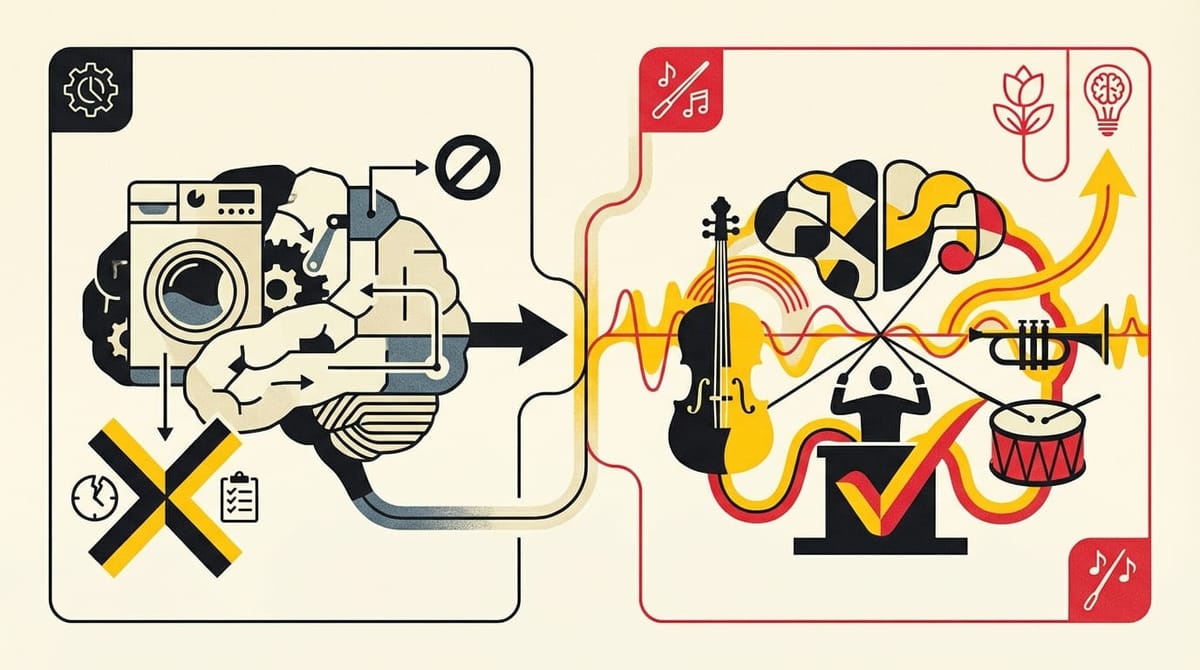
Your brain isn't a washing machine—load, press, results. It's an orchestra where everything connects to everything, and until you understand that, no productivity hack will save you.

Hello, Brain: Why Productivity Methods Don't Work
Sunday, 11 PM. Reading the same textbook chapter for the third time. The text looks familiar. I think: I know this. Tomorrow's exam — blank.
Sound familiar? If not, you're either a genius or lying. But if yes — welcome to the club. We're all here.
This isn't a memory problem. It's a problem of understanding how the brain works. Here's the thing: we treat our own heads like washing machines — load it up, press a button, get results in forty minutes. But the brain is, shall we say, a more interesting device.
I spent years collecting productivity courses. Gigabytes of material. That I never got around to. Sure, you could blame laziness — convenient, but wrong. The problem runs deeper: we don't understand the basic mechanics of how the brain works. Which means we're trying to drive a car without knowing where the steering wheel is.
But before we dive into theory — one practical exercise. Close this article. Write down everything you remember about how the brain works. Open it again. Compare.
This is retrieval practice. Works 1.5x better than re-reading. And no, it's not magic — it's science, just uncomfortably simple.
How the Brain Works
The brain controls breathing. Heartbeat. Consciousness. The decision not to text your ex at 3 AM. But most importantly — the brain is constantly learning.
What's automatic now (surfing the internet, typing, watching three tabs at once) once required massive effort. Learning is the brain rewiring itself to adapt to its environment. Doesn't matter which one: work, relationships, hobbies, a new city.
Here's where we need to bust a popular myth. The old "triune brain" model — reptilian, limbic, neocortex — makes a beautiful metaphor and a convenient lecture opener. Problem is, neuroscience abandoned it back in the 2000s. The brain doesn't work like a three-layer cake. It's an integrated system: different areas interact rather than compete.
Think of an orchestra. There's no "primitive" bass section and "advanced" violin section. There's one unified sound where every instrument matters.
What to do: think of the brain as a network where everything connects to everything. This isn't just a metaphor — it's a principle that changes how you approach learning.
What Learning Is Made Of
Here's a fact that might make your head spin: all of reality is constructed by the brain during development. The smartphone in your hands isn't just an object. It's the result of titanic work modeling objects of this type.